The Book of Daniel
King James Version

Chapter

Daniel, in the Christian Canon of scriptures, is included among the major prophets. A credible reason for this placement is the fact that Jesus referred to him as a prophet (Matt 24:15). In the Talmud, or corresponding Hebrew record of the same, it is placed among the “Writings”. This in part is due to the belief of some scholars that the body of the book of Daniel is not a predictive prophecy but rather a pseudonymously written encouragement to the occupants of the Maccabean period. One of the presuppositions that drives this belief is an underlying philosophical position that in order for the book of Daniel to read, with regard to the Maccabean period, like yesterday’s newspaper it must have been written during this period. To carry this philosophical position to its logical conclusion would be to undermine the belief in the miraculous and eventually gut the body of scripture of any supernatural influence of the divine. It would call into question many of the miracles of the scripture such as the parting of the red sea, Jonah, and all the way up to and including the resurrection of the dead. Perhaps this is truly the ultimate motive of this position from the beginning. The position of this writer is that the book of Daniel was rightly placed among the prophets.

When it comes to the interpretation of prophecy the most obvious way is to let the prophet tell us what it means. This type of interpretation occurs multiple times in this book with the prophet laying out what is meant as he receives the interpretation from the one who gives the vision. One of our first observations of a prophecy must always be with an eye on the setting, time, or context in which the prophecy occurs. A valid understanding simply cannot be achieved without knowing the current events of the time the prophecy is given. The writings of prophets are typically given with chronological and geographical markers, for instance, the book of Isaiah opens with these words; The vision of Isaiah the son of Amoz, which he saw concerning Judah and Jerusalem in the days of Uzziah, Jotham, Ahaz, and Hezekiah, kings of Judah. Notice clear geographical and chronological markers for the interpretation of the vision. In chapter 6 we find that Isaiah becomes a prophet in the last year of King Uzziah 740BC and continues through the reign of Hezekiah 686BC. The major historical event of this time is when the Assyrians from the north swept down and obliterated the ten northern tribes of Israel.  To ignore these markers of time and geography would be to err. Similarly, the books of Jeremiah and Ezekiel open with clear boundaries with which to receive their content. More specifically Ezekiel has thirteen visions with these markers placed upon them.  Simply stated, a prophecy cannot mean today what it did not mean within the confines placed upon it by the prophets. If we take the liberty to disregard these parameters, we have taken the first step on a slippery slope to disregard the content/body of the writing but conversely, if we pay attention to them, we will arrive at a better understanding of their meaning.


The book of Daniel can be confusing from the standpoint that it is not laid out in a chronological fashion but rather thematically. Although the book opens with Daniel in his youth it does not follow this progression linearly. It opens, “In the third year of the reign of Jehoiakim king of Judah” (605BC). It is at this time that the king of Judah is taken captive along with vessels and treasures from the house of God. Jerusalem becomes a vassal state paying tribute to Babylon. In order to facilitate this process, there were taken captive young men of the king’s seed and princes. These young men were placed in the care of Ashpenaz the master of the eunuchs and were basically held hostage as they learned the language and customs of the Babylonians. Daniel was one of the young men caught in this tragic place sandwiched between two nations. Although he is well versed in the customs of the Babylonians, we find him clinging tenaciously to customs from his early childhood. Not wanting to defile himself with the heathen king’s meat he, along with his fellow hostages Hananiah, Mishael, and Azariah, entreats Ashpenaz that they may abstain and only eat pulse and drink water for their diplomatic duties. Upon the conclusion of the agreed trial period, Daniel and his fellows appear fatter and fairer than their counterparts. By the grace of God, they were in all matters of wisdom and understanding found to be better than all the magicians and astrologers that were in the king’s realm.

Daniel’s Captivity in Babylon

1. In the third year of the reign of Jehoiakim king of Judah came Nebuchadnezzar king of Babylon unto Jerusalem, and besieged it.

2 Ki 24:1-2; 2 Ch 36:5-6; Jr 25:1; 52:12, 28-30

2. And the Lord gave Jehoiakim king of Judah into his hand, with part of the vessels of the house of God: which he carried into the land of Shinar to the house of his god; and he brought the vessels into the treasure house of his god.

2 Ki 24:13; 2Ch 36:7-10; Ezr 5:14; Jr 27:19-22; Dn 5:2; Gn 10:10; Gn 11:2; Is 11:11; Zc 5:11

3. And the king spake unto Ashpenaz the master of his eunuchs, that he should bring certain of the children of Israel, and of the king's seed, and of the princes; 

2 Ki 20:18; 24:15; Is 39:7; Dn 1:9

4. Children in whom was no blemish, but well favoured, and skilful in all wisdom, and cunning in knowledge, and understanding science, and such as had ability in them to stand in the king's palace, and whom they might teach the learning and the tongue of the Chaldeans.

Dn 9:22; Is 39:7; Jr 5:15

5. And the king appointed them a daily provision of the king's meat, and of the wine which he drank: so nourishing them three years, that at the end thereof they might stand before the king.

2 Ki 25:30; Dn 11:26; Gn 41:46; 1 Sa 16:22

6. Now among these were of the children of Judah, Daniel, Hananiah, Mishael, and Azariah:

Ezk 14:14,20; 28:3

7. Unto whom the prince of the eunuchs gave names: for he gave unto Daniel the name of Belteshazzar; and to Hananiah, of Shadrach; and to Mishael, of Meshach; and to Azariah, of Abednego.

2 Ki 23:34; 24:17; Dn 4:8,19; 5:12; 10:1

Faithfulness in Babylon

8. But Daniel purposed in his heart that he would not defile himself with the portion of the king's meat, nor with the wine which he drank: therefore he requested of the prince of the eunuchs that he might not defile himself.

Pr 23:1-2; Lv 3:17; 11:47; Ps 141:4; Ezk 4:13; Hos 9:3; Ac 10:11-15

9. Now God had brought Daniel into favour and tender love with the prince of the eunuchs. 10 And the prince of the eunuchs said unto Daniel, I fear my lord the king, who hath appointed your meat and your drink: for why should he see your faces worse liking than the children which are of your sort? then shall ye make me endanger my head to the king.

Gn 39:21; 1 Ki 8:50; Jb 5:15; Ps 106:46; Pr 16:7; Ac 7:10

10. And the prince of the eunuchs said unto Daniel, I fear my lord the king, who hath appointed your meat and your drink: for why should he see your faces worse liking than the children which are of your sort? then shall ye make me endanger my head to the king.

11. Then said Daniel to Melzar, whom the prince of the eunuchs had set over Daniel, Hananiah, Mishael, and Azariah,

12. Prove thy servants, I beseech thee, ten days; and let them give us pulse to eat, and water to drink.

13. Then let our countenances be looked upon before thee, and the countenance of the children that eat of the portion of the king's meat: and as thou seest, deal with thy servants.

14. So he consented to them in this matter, and proved them ten days.

15. And at the end of ten days their countenances appeared fairer and fatter in flesh than all the children which did eat the portion of the king's meat.

Ex 23:25

16. Thus Melzar took away the portion of their meat, and the wine that they should drink; and gave them pulse.

Faithfulness Rewarded

17. As for these four children, God gave them knowledge and skill in all learning and wisdom: and Daniel had understanding in all visions and dreams.

Jb 32:8; Ac 7:22; Jm 1:5; 1 Ki 3:10-12; Dn 2:19,30; 4:18-19; 7:1

18. Now at the end of the days that the king had said he should bring them in, then the prince of the eunuchs brought them in before Nebuchadnezzar.

Gn 41:37-39

19. And the king communed with them; and among them all was found none like Daniel, Hananiah, Mishael, and Azariah: therefore stood they before the king.

Gn 41:37-39

20.  And in all matters of wisdom and understanding, that the king enquired of them, he found them ten times better than all the magicians and astrologers that were in all his realm.

Gn 31:7; Nm 14:22; Jb 19:3; Pr 3:13-18; Dn 5:11-12

21. And Daniel continued even unto the first year of king Cyrus.

Ezr 1:1-2; Is 45:1; Dn 6:28; 10:1

Apparently, somewhere during the first chapter (in reference to time), King Nebuchadnezzar had a dream. We find in the first chapter that three years were appointed to prepare the young Hebrew men for their duties as they stood before the king. The second chapter opens with the reference of time being in the second year of Nebuchadnezzar’s reign so there must be some overlap not indicated by the chapter break. 

The king brought in the intelligence department and required of them the dream and its interpretation. Much to the shock and dismay of the wise ones, the only remnants of the dream were a memory of its occurrence and ensuing disturbance, but the details had vanished. This however did not prevent the king from demanding of them a recitation and subsequent interpretation. It isn’t much of a stretch to think if one has some kind of special gift to give interpretations that they could also provide knowledge of the original dream. As with all such divination, so much of its ability resides not in the practitioner but in the subjective persuasions of the client. The demands of the king manifested the inadequacies of these disciplines to operate independent of the superstitions of the subject, while at the same time setting the stage for God to showcase his adequacy. Their reply was without equivocation that his demand was impossible with mortals and could only be accomplished by deities whose dwellings, apparently, were not in Babylon. Therefore, no such demand had ever been made of any man by any ruler. The abject failure of this department prompted a command that they were to be mutilated and their houses made a dunghill.

When Arioch started rounding up all the practitioners so they could be slain, Daniel and his fellows were taken in the net. Further investigation revealed to Daniel the matter so he petitioned the king for a little time and he would satisfy his demands. Time was granted and Daniel shared the conditions with his fellows who immediately petitioned the supreme court by prayer and fasting. God accommodated Daniel with a vision in the night to which Daniel responded with elation and praise for the God of heaven.  Daniel let Arioch know that he had the goods and prompted him to present him to the king affording Arioch the political opportunity. Obvious from the wording of Arioch’s use of the personal pronoun, “I”, in, “I have found”, he wanted as much credit as he could wrangle out of the situation. Also obvious by the king’s words the king remained skeptical. What isn’t so obvious is whether Daniel knew or would have ever known about his gift in such instances if it hadn’t been for the grievous demands made of him? Sometimes great difficulty arises only to demonstrate God’s efficacy either in us or through us.

Nebuchadnezzar’s Dream

1. And in the second year of the reign of Nebuchadnezzar Nebuchadnezzar dreamed dreams, wherewith his spirit was troubled, and his sleep brake from him.

Gn 41:1,8; Est 6:1; Dn 6:18

2. Then the king commanded to call the magicians, and the astrologers, and the sorcerers, and the Chaldeans, for to shew the king his dreams. So they came and stood before the king.

Dt 18:10,11; 2Ch 33:6; Is 47:9,12

3. And the king said unto them, I have dreamed a dream, and my spirit was troubled to know the dream.

4. Then spake the Chaldeans to the king in Syriack, O king, live for ever: tell thy servants the dream, and we will shew the interpretation.

Ezr 4:7; Is 36:11; 1 Ki 1:31; Dn 3:9; 5:10; 6:6,21

*Daniel 2:4–7:28 is written in Aram.

5. The king answered and said to the Chaldeans, The thing is gone from me: if ye will not make known unto me the dream, with the interpretation thereof, ye shall be cut in pieces, and your houses shall be made a dunghill.

Ezr 6:11; Dn 3:29

6. But if ye shew the dream, and the interpretation thereof, ye shall receive of me gifts and rewards and great honour: therefore shew me the dream, and the interpretation thereof.

Dn 5:7,16

7. They answered again and said, Let the king tell his servants the dream, and we will shew the interpretation of it.

8. The king answered and said, I know of certainty that ye would gain the time, because ye see the thing is gone from me.

9. But if ye will not make known unto me the dream, there is but one decree for you: for ye have prepared lying and corrupt words to speak before me, till the time be changed: therefore tell me the dream, and I shall know that ye can shew me the interpretation thereof.

Is 41:23

10. The Chaldeans answered before the king, and said, There is not a man upon the earth that can shew the king's matter: therefore there is no king, lord, nor ruler, that asked such things at any magician, or astrologer, or Chaldean.

Dn 5:11-16

11. And it is a rare thing that the king requireth, and there is none other that can shew it before the king, except the gods, whose dwelling is not with flesh.

Ex 29:45; Is 57:15

12. For this cause the king was angry and very furious, and commanded to destroy all the wise men of Babylon.

Ps 76:10; Dn 2:24; 3:13,19

13. And the decree went forth that the wise men should be slain; and they sought Daniel and his fellows to be slain.

14. Then Daniel answered with counsel and wisdom to Arioch the captain of the king's guard, which was gone forth to slay the wise men of Babylon:

Gn 37:36

15. He answered and said to Arioch the king's captain, Why is the decree so hasty from the king? Then Arioch made the thing known to Daniel.

Dn 3:22

16. Then Daniel went in, and desired of the king that he would give him time, and that he would shew the king the interpretation.

17. Then Daniel went to his house, and made the thing known to Hananiah, Mishael, and Azariah, his companions:

18. That they would desire mercies of the God of heaven concerning this secret; that Daniel and his fellows should not perish with the rest of the wise men of Babylon.

Mt 18:19; Jr 33:3; Mal 3:18

19. Then was the secret revealed unto Daniel in a night vision. Then Daniel blessed the God of heaven.

Nm 12:6; Jb 33:15-16; Am 3:7

20. Daniel answered and said, Blessed be the name of God for ever and ever: for wisdom and might are his:

1 Ch 29:10; Ps 72:18; Lk 1:68; Jb 12:13; Is 28:29

21. And he changeth the times and the seasons: he removeth kings, and setteth up kings: he giveth wisdom unto the wise, and knowledge to them that know understanding:

1 Ch 29:11-12; Dn 4:17; Rm 13:1; Jb 12:16-22

22. He revealeth the deep and secret things: he knoweth what is in the darkness, and the light dwelleth with him.

Jb 12:22; Ps 139:12; Jr 23:24; Am 4:13; Heb 4:13; Jn 1:4-5; 1 Ti 6:16; Jm 1:17; 1 Jn 1:5

23. I thank thee, and praise thee, O thou God of my fathers, who hast given me wisdom and might, and hast made known unto me now what we desired of thee: for thou hast now made known unto us the king's matter.

Gn 31:42; Ex 3:15; Dt 26:7; 1 Ch 12:17; 29:18; Dn 1:17-18

24. Therefore Daniel went in unto Arioch, whom the king had ordained to destroy the wise men of Babylon: he went and said thus unto him; Destroy not the wise men of Babylon: bring me in before the king, and I will shew unto the king the interpretation.

Dn 2:14-15; Ac 27:24

25. Then Arioch brought in Daniel before the king in haste, and said thus unto him, I have found a man of the captives of Judah, that will make known unto the king the interpretation.

Ezr 4:1; 6:16,19-20; 10:7,16; Dn 5:13

26. The king answered and said to Daniel, whose name was Belteshazzar, Art thou able to make known unto me the dream which I have seen, and the interpretation thereof?

Dn 1:7; 5:12, 16

27. Daniel answered in the presence of the king, and said, The secret which the king hath demanded cannot the wise men, the astrologers, the magicians, the soothsayers, shew unto the king;

Dn 1:20; 4:7; 5:7,11

28. But there is a God in heaven that revealeth secrets, and maketh known to the king Nebuchadnezzar what shall be in the latter days. Thy dream, and the visions of thy head upon thy bed, are these;

Is 2:2; Dn 10:14; Hos 3:5; Mic 4:1; Dn 4:5; 7:15

29. As for thee, O king, thy thoughts came into thy mind upon thy bed, what should come to pass hereafter: and he that revealeth secrets maketh known to thee what shall come to pass.

Rv 1:1; Jb 12:20-22; Dn 2:45

30. But as for me, this secret is not revealed to me for any wisdom that I have more than any living, but for their sakes that shall make known the interpretation to the king, and that thou mightest know the thoughts of thy heart.

Eph 3:3; Gn 41:16; Ec 3:18; Am 4:13; Ac 3:12

Daniel had no more than started his recitation of the king’s dream before the king had an epiphany that Daniel’s God was the God of gods. Daniel of course did not claim any superiority over any other man but gave only God the glory. It is interesting to note the way God uses the characters of this story: 
  • He initially gave the dream to the heathen king and not to Daniel
  • He does not permit the king to proceed without bringing Daniel to the fore
  • He manifests the frailties of the king’s counselors
  • There is no revelation without God in the picture

Daniel starts in verse 31 with a voice of authority stating what had come into the king’s mind by way of the dream. He describes an image of whose brightness was excellent and whose form was terrible. The image’s head was of fine gold, his breast and arms of silver, his belly and thighs of brass, his legs of iron, and his feet of two elements: iron and clay. While the king beheld, a stone cut without hands smote the image upon his feet resulting in the crumbling of the image. Being pulverized it became like the chaff of the summer threshing floor which the wind blew away. This image was given to convey the succession of nations diminishing in power and glory beginning with Babylon and her respective king. Note well the devaluation of the metal as it descends respectively from the head to the feet. This is indicative of the deterioration of the state of the then-governed world. The pinnacle of the governments, being the very one to whom the vision of the image was given.   This progression/succession of nations plays out in history just as Daniel prophesied that it would even though Nebuchadnezzar tried to co-opt/influence future events to his own advantage. This image of Daniel representing the succession of nations covers a period of roughly 637 years from the time Daniel was taken captive with his fellows in 605 B.C. to 32 A.D. the year of the passion of our Lord.
Head of gold = Babylon/Nebuchadnezzar

The Babylonian empire continues until 539 B.C. when Darius the Median, at 62 years of age, invades and conquers the kingdom.

Breast and arms of silver= Persia/Darius the Median

This Persian empire continues from 539 B.C. to 331 B.C. for a total of roughly 208 years.

Belly and thighs of brass= Greece/Alexander the great

The Persian empire was conquered by Alexander the Great after he had risen to power in Macedonia. His father Phillip had transformed it, into a military power house, prior to his ascendance to power, and it was ready for conquest. He conquered and ruled for about ten years but died at the young age of 32. His dominion was divided between his four generals Ptolemy, Seleucus, Cassander, and Antigonus. This kingdom was in power from 331 B.C. to 63 B.C. During the later portion of this time the Romans were on the rise in power and influence for about 83 years. 

Legs of Iron/feet iron mixed with clay=Romans Caesars

The Roman empire was established and held power from 146 B.C. to 476 A.D.

The Stone = Kingdom of Heaven/Christianity

About A.D. 32, the kingdom of God was set up on the earth and continues until the time now present and forevermore.

Note: These dates may vary according to source but bear in mind the purpose of this exercise is not to be exact on specific dates but to validate the fulfillment of this prophecy in history.

The Dream’s Interpretation

31-35. Thou, O king, sawest, and behold a great image. This great image, whose brightness was excellent, stood before thee; and the form thereof was terrible. This image's head was of fine gold, his breast and his arms of silver, his belly and his thighs of brass, His legs of iron, his feet part of iron and part of clay. Thou sawest till that a stone was cut out without hands, which smote the image upon his feet that were of iron and clay, and brake them to pieces. Then was the iron, the clay, the brass, the silver, and the gold, broken to pieces together, and became like the chaff of the summer threshingfloors; and the wind carried them away, that no place was found for them: and the stone that smote the image became a great mountain, and filled the whole earth.

v.34: Jb 34:20; Lam 4:6; Dn 8:25; 2Co 5:1; Mt 21:44; Lk 20:18; Ps 2:9; Is 60:12

v.35: Ps 1:4; Is 17:13; 41:15,16; Hos 13:3; Is 2:2; Mic 4:1
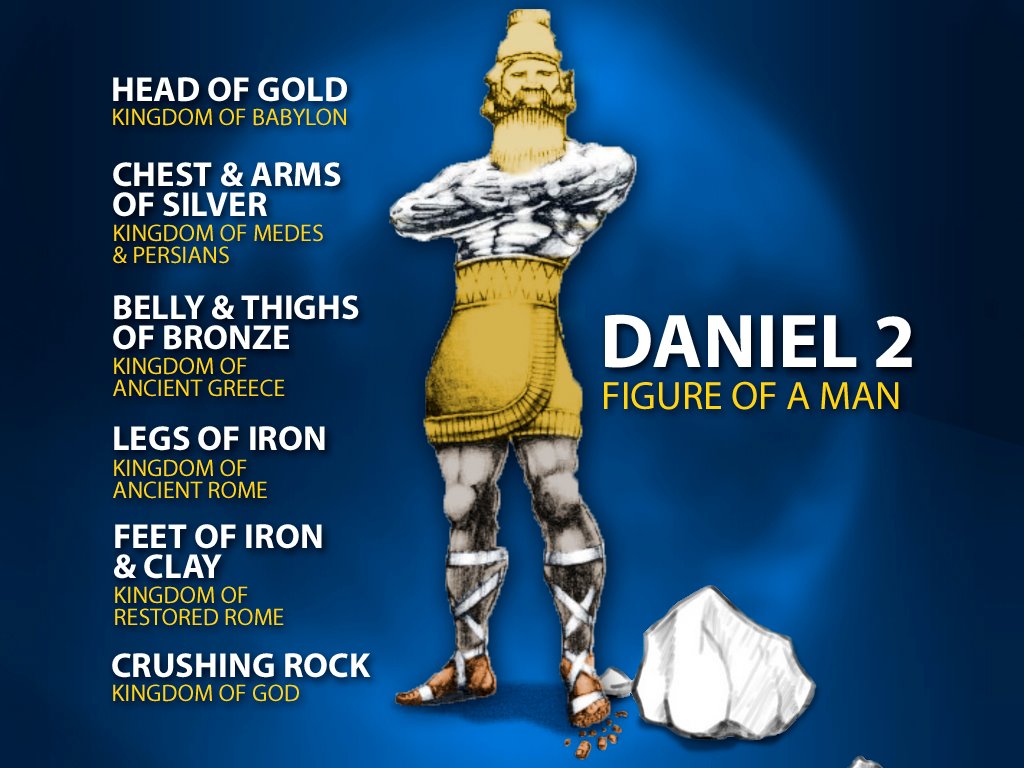
Statue described in Daniel 2 verses 31 through 35

36. This is the dream; and we will tell the interpretation thereof before the king.

37. Thou, O king, art a king of kings: for the God of heaven hath given thee a kingdom, power, and strength, and glory.

Is 47:5; Jr 27:6,7; Ezk 26:7; Pr 8:15

38. And wheresoever the children of men dwell, the beasts of the field and the fowls of the heaven hath he given into thine hand, and hath made thee ruler over them all. Thou art this head of gold.

Ps 50:10; Jr 27:6; 28:14; Dn 4:21

39. And after thee shall arise another kingdom inferior to thee, and another third kingdom of brass, which shall bear rule over all the earth.

Dn 5:28,31; 7:6

40. And the fourth kingdom shall be strong as iron: forasmuch as iron breaketh in pieces and subdueth all things: and as iron that breaketh all these, shall it break in pieces and bruise.

Dn 7:7,23

41. And whereas thou sawest the feet and toes, part of potters' clay, and part of iron, the kingdom shall be divided; but there shall be in it of the strength of the iron, forasmuch as thou sawest the iron mixed with miry clay.

42. And as the toes of the feet were part of iron, and part of clay, so the kingdom shall be partly strong, and partly broken.

43. And whereas thou sawest iron mixed with miry clay, they shall mingle themselves with the seed of men: but they shall not cleave one to another, even as iron is not mixed with clay.

44. And in the days of these kings shall the God of heaven set up a kingdom, which shall never be destroyed: and the kingdom shall not be left to other people, but it shall break in pieces and consume all these kingdoms, and it shall stand for ever.

Ps 145:13; Ezk 37:25; Dn 4:3; 6:26; 7:14; Lk 1:33; Ps 2:9; Mt 21:44

45. Forasmuch as thou sawest that the stone was cut out of the mountain without hands, and that it brake in pieces the iron, the brass, the clay, the silver, and the gold; the great God hath made known to the king what shall come to pass hereafter: and the dream is certain, and the interpretation thereof sure.

Is 28:16; Dn 2:34; Jr 32:18-19; Dn 2:29; Mal 1:11

We conclude this chapter with the king Nebuchadnezzar falling on his face to worship Daniel and commanding that they should offer an oblation and sweet odors to him. The king stated unabashedly that, Daniels God was a God of gods, a Lord of kings, and a revealer of secrets. He promoted Daniel and made him a great man, gave him many gifts, and made him ruler over the whole province of Babylon, and chief of the governors over the intelligence department. Daniel then requested the king set Shadrach, Meshach, and Abednego over the affairs of the province of Babylon but Daniel sat in the gate of the king.

Nebuchadnezzar’s Response

46. Then the king Nebuchadnezzar fell upon his face, and worshipped Daniel, and commanded that they should offer an oblation and sweet odours unto him.

Mt 8:2; Ac 10:25; 14:13; Rv 19:10; 22:8

47. The king answered unto Daniel, and said, Of a truth it is, that your God is a God of gods, and a Lord of kings, and a revealer of secrets, seeing thou couldest reveal this secret.

Dt 10:17; Ps 136:2,3; 1 Ti 6:15; Rv 17:14; 19:16; Am 3:7

48. Then the king made Daniel a great man, and gave him many great gifts, and made him ruler over the whole province of Babylon, and chief of the governors over all the wise men of Babylon.

Gn 41:41; Dn 3:1,12,30

49. Then Daniel requested of the king, and he set Shadrach, Meshach, and Abednego, over the affairs of the province of Babylon: but Daniel sat in the gate of the king.

Dn 1:17; 3:12; Est 2:19,21; Am 5:15

This chapter allows us to see what one powerful king will do with the gift of foreknowledge, instead of preparing himself and becoming acquainted with the Great God that bestowed such a gift. We observe behavior demonstrated in such a way as to typify the unregenerate heart of all humankind. Humanity is idolatrous by nature and seeks to impose its will on the environment rather than conform to the designs of the Creator. This chapter can be viewed as an allegory of humanity’s initial response to divine revelation.

Nebuchadnezzar made an image of gold (not unlike the one seen in previous visions with a few exceptions) whose height was sixty cubits (90 ft) and width six cubits (9 ft). The notable difference between the Image that Daniel saw in the previous chapter, and the one that Nebuchadnezzar sets up in the plain of Dura is that this one is made of all gold. It shouldn’t go unnoticed that gold represents Babylon/Nebuchadnezzar. He is trying to fashion the future according to his own will and insinuate himself into it without regard for the God of gods (who so graciously gave the vision to the king as well as provided the interpretation).

We see the king not only try to influence the future but also require that all consent and conform to his will. Nebuchadnezzar gathered all of the ruling class (from governors to sheriffs) in the kingdom to the dedication of the image. It was heralded that, when they heard the blended music from all manner of instruments, they were to fall down and worship the image. The penalty for noncompliance was to be cast into the midst of a burning, fiery furnace.

Nebuchadnezzar’s Gold Statue

1. Nebuchadnezzar the king made an image of gold, whose height was threescore cubits, and the breadth thereof six cubits:Lit statue, its height 60 cubits, its width six cubits he set it up in the plain of Dura, in the province of Babylon.

1 Ki 12:28; Is 46:6; Jr 16:20; Hos 2:8; 8:4; Hab 2:19, Gn 11:2; Dn 2:48-49

2. Then Nebuchadnezzar the king sent to gather together the princes, the governors, and the captains, the judges, the treasurers, the counsellors, the sheriffs, and all the rulers of the provinces, to come to the dedication of the image which Nebuchadnezzar the king had set up.

Ezr 8:36; Dn 2:48; 6:1-7

3. Then the princes, the governors, and captains, the judges, the treasurers, the counsellors, the sheriffs, and all the rulers of the provinces, were gathered together unto the dedication of the image that Nebuchadnezzar the king had set up; and they stood before the image that Nebuchadnezzar had set up.

4. Then an herald cried aloud, To you it is commanded, O people, nations, and languages,

5. That at what time ye hear the sound of the cornet, flute, harp, sackbut, psaltery, dulcimer, and all kinds of musick, ye fall down and worship the golden image that Nebuchadnezzar the king hath set up:

Dn 2:46

6. And whoso falleth not down and worshippeth shall the same hour be cast into the midst of a burning fiery furnace.

Jr 29:22; Mt 13:42,50; Rv 9:2

7. Therefore at that time, when all the people heard the sound of the cornet, flute, harp, sackbut, psaltery, and all kinds of musick, all the people, the nations, and the languages, fell down and worshipped the golden image that Nebuchadnezzar the king had set up.

It appears there could be some jealously underway as it was Chaldeans accusing Jews of disregard for Nebuchadnezzar and his gods and a refusal to worship the golden image that he had set up. Inquiry was made as to the verity of the accusation and the Hebrews were offered another opportunity to comply. The young men answered without carefulness, “If it be so, our God is able to deliver us from the burning, fiery furnace, and he will deliver us out of thy hand, O king. But if not, be it known unto thee, O king, that we will not serve thy gods, nor worship the golden image which thou hast set up”. 

In a rage, he commanded the furnace to be heated seven times hotter and the insolent chaps to be “bound in their coats, hosen, hats, and other garments, then cast into the midst of the burning, fiery furnace”. Because of the urgency of the king’s command, precautions were abandoned as it was carried out, and the mightiest men of his army were slain by the fire. The three offenders fell bound into the furnace.

The Furnace Of Blazing Fire

8. Wherefore at that time certain Chaldeans came near, and accused the Jews.

Ezr 4:12-16; Est 3:8-9; Dn 6:12,24

9. They spake and said to the king Nebuchadnezzar, O king, live for ever.

10. Thou, O king, hast made a decree, that every man that shall hear the sound of the cornet, flute, harp, sackbut, psaltery, and dulcimer, and all kinds of musick, shall fall down and worship the golden image:

Dn 4:6; 6:26

11. And whoso falleth not down and worshippeth, that he should be cast into the midst of a burning fiery furnace.

12. There are certain Jews whom thou hast set over the affairs of the province of Babylon, Shadrach, Meshach, and Abednego; these men, O king, have not regarded thee: they serve not thy gods, nor worship the golden image which thou hast set up.

Dn 1:7, 6:13

13. Then Nebuchadnezzar in his rage and fury commanded to bring Shadrach, Meshach, and Abednego. Then they brought these men before the king.

Dn 2:12

14. Nebuchadnezzar spake and said unto them, Is it true, O Shadrach, Meshach, and Abednego, do not ye serve my gods, nor worship the golden image which I have set up?

Jer 50:2

15. Now if ye be ready that at what time ye hear the sound of the cornet, flute, harp, sackbut, psaltery, and dulcimer, and all kinds of musick, ye fall down and worship the image which I have made; well: but if ye worship not, ye shall be cast the same hour into the midst of a burning fiery furnace; and who is that God that shall deliver you out of my hands?

Ex 5:20; 2 Ki 18:35; Is 36:18

16. Shadrach, Meshach, and Abednego, answered and said to the king, O Nebuchadnezzar, we are not careful to answer thee in this matter.

17. If it be so, our God whom we serve is able to deliver us from the burning fiery furnace, and he will deliver us out of thine hand, O king.

1 Sa 17:37; Jb 5:19; Jr 15:20,21; 2 Co 1:10

18. But if not, be it known unto thee, O king, that we will not serve thy gods, nor worship the golden image which thou hast set up.

Heb 11:25, Jos 24:15

19. Then was Nebuchadnezzar full of fury, and the form of his visage was changed against Shadrach, Meshach, and Abednego: therefore he spake, and commanded that they should heat the furnace one seven times more than it was wont to be heated.

Est 7:7

20. And he commanded the most mighty men that were in his army to bind Shadrach, Meshach, and Abednego, and to cast them into the burning fiery furnace.

21. Then these men were bound in their coats, their hosen, and their hats, and their other garmentsThe identity of these articles of clothing is uncertain., and were cast into the midst of the burning fiery furnace.

22. Therefore because the king's commandment was urgent, and the furnace exceeding hot, the flame of the fire slew those men that took up Shadrach, Meshach, and Abednego.

Dn 2:15

23. And these three men, Shadrach, Meshach, and Abednego, fell down bound into the midst of the burning fiery furnace.

The king was astonished to see, not three, but four men and not bound but loose and walking around. “The form of the fourth was like the Son of God”. It behooves us to note that the only effect of the fire was on the mightiest of the king’s army and the bindings of the courageous men. They were called forth from the midst of the furnace and It was witnessed by all in attendance that the fire couldn’t inflict the smell of smoke or singe even a single hair of their head.

Once again, we see Nebuchadnezzar Bless the God of Shadrach, Meshach, and Abednego and decree that if any spoke amiss of their God then their house would be made a dunghill. The king declared that there is no other God that can deliver after this sort and promptly promoted the three men in the province of Babylon.

Delivered From The Fire

24. Then Nebuchadnezzar the king was astonied, and rose up in haste, and spake, and said unto his counsellors, Did not we cast three men bound into the midst of the fire? They answered and said unto the king, True, O king.

Dn 4:19

25. He answered and said, Lo, I see four men loose, walking in the midst of the fire, and they have no hurt; and the form of the fourth is like the Son of God.

Ps 91:3-9; Is 43:2; Mt 14:33; Mk 1:1; Lk 1:35; Jn 3:18; Ac 9:20

26. Then Nebuchadnezzar came near to the mouth of the burning fiery furnace, and spake, and said, Shadrach, Meshach, and Abednego, ye servants of the most high God, come forth, and come hither. Then Shadrach, Meshach, and Abednego, came forth of the midst of the fire.

Dn 4:2

27. And the princes, governors, and captains, and the king's counsellors, being gathered together, saw these men, upon whose bodies the fire had no power, nor was an hair of their head singed, neither were their coats changed, nor the smell of fire had passed on them.

Heb 11:34

28. Then Nebuchadnezzar spake, and said, Blessed be the God of Shadrach, Meshach, and Abednego, who hath sent his angel, and delivered his servants that trusted in him, and have changed the king's word, and yielded their bodies, that they might not serve nor worship any god, except their own God.

Heb 1:14; Ps 34:7; Is 37:36; Ac 5:19; 12:7; 22:4-5; Is 12:2; 26:3-4; Jer 17:7

29. Therefore I make a decree, That every people, nation, and language, which speak any thing amiss against the God of Shadrach, Meshach, and Abednego, shall be cut in pieces, and their houses shall be made a dunghill: because there is no other God that can deliver after this sort.

Dn 4:6; Ezr 6:11; Dn 2:5

30. Then the king promoted Shadrach, Meshach, and Abednego, in the province of Babylon.

Dn 2:48-49

Lorem ipsum dolor sit amet, consectetur adipisicing elit. Optio, neque qui velit. Magni dolorum quidem ipsam eligendi, totam, facilis laudantium cum accusamus ullam voluptatibus commodi numquam, error, est. Ea, consequatur.